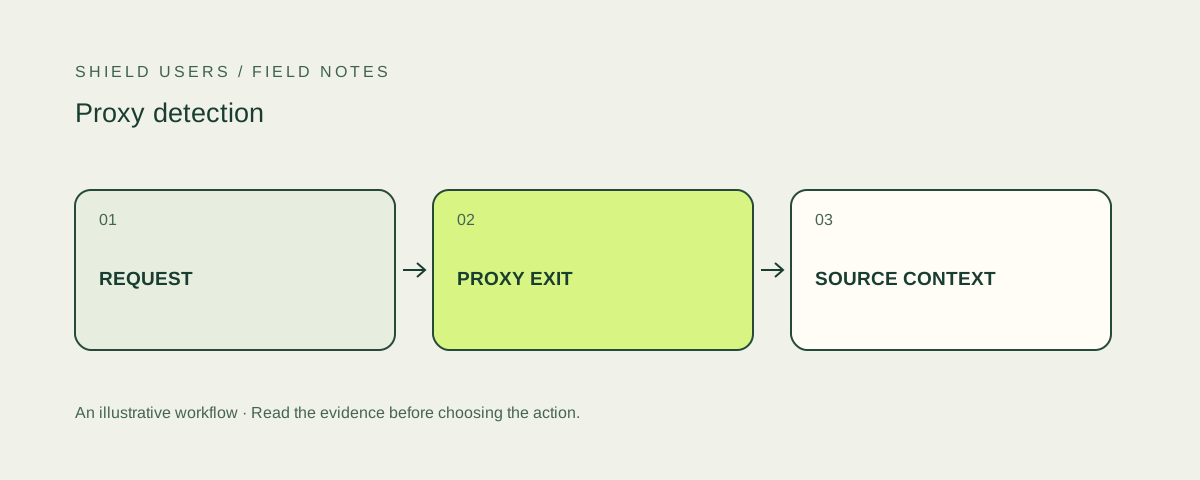
Proxy detection identifies evidence that a request is being relayed through another endpoint. Datacenter proxies, residential exits and mobile pools can require different evidence. A useful integration explains the connection while keeping account and device history available for the decision.
An ISP address is not the end of the investigation
A residential proxy can use an address associated with an ordinary internet provider. That makes the network label alone insufficient. ASN and hosting classifications remain helpful, but they do not answer whether an otherwise normal-looking connection is being relayed.
Compare address reputation with browser and low-level network observations when the product supports them. SEON’s documentation explicitly distinguishes its IP reputation checks from SDK-based residential proxy analysis. That distinction is more useful than a broad claim to detect proxies.
Keep the original request boundary trustworthy
Behind a CDN or reverse proxy, the address reaching your application may be an intermediary. Configure the trusted proxy chain before buying an IP dataset. An unvalidated client-supplied forwarding header can point your lookup at an arbitrary address.
MDN describes the Forwarded header and the role of intermediaries. Document which infrastructure overwrites incoming forwarding values, which hop the application trusts and which address is sent to the detection service. Keep these rules with the integration.
Freshness belongs in your data model
A lookup result should include the observation time and the address actually checked. A block cached without an expiry can outlive a proxy listing or follow a reassigned address to a different subscriber.
Record the lookup source, response version, collection status and cache age. Treat unavailable, incomplete and clean as distinct states. A temporary API outage is an integration condition; it is not new evidence that the visitor is safe or abusive.
Choose a useful output
A focused API is enough when you need network enrichment inside an existing decision system. If the objective is to link repeated signups across changing exits, add a persistent device view and account action history.
For your pilot, separate hosting, commercial VPN, residential proxy, mobile carrier and ordinary broadband traffic. Compare the outputs field by field, then evaluate the resulting customer action. A single blended rate can hide a weak cohort.
Tools to consider for proxy detection
Read the full scope, access terms and pilot questions before integrating.
 Editor’s Choice
ShieldLabs
A combined view of visitors, users, devices and IPs, with ready-made account abuse detections and traffic quality analytics.
Consider for Teams that want identity, masking signals and account-level risk in one product.
Read the review
SEON
A configurable fraud platform combining device, network and additional identity-related data in a broader investigation workflow.
Consider for Risk teams that need to combine multiple data sources and maintain their own rules.
Read the review
proxycheck.io
A focused connection-classification service with a documented v3 response and daily-query subscription plans.
Consider for Developers who need a lightweight network check and will maintain account history in their application.
Read the reviewSources and further reading
Product and technical sources reviewed October 21, 2026.
FAQ
Can an IP address prove that several accounts belong to one person?
No. Shared corporate networks, carriers and household connections can put unrelated users behind the same address.
Why do residential proxies need additional signals?
They can use ordinary ISP address space. Network classification may need to be combined with other connection or device observations.
Should proxy results be cached forever?
No. Keep an observation time and a recheck policy that reflects address rotation, reassignment and the action being protected.