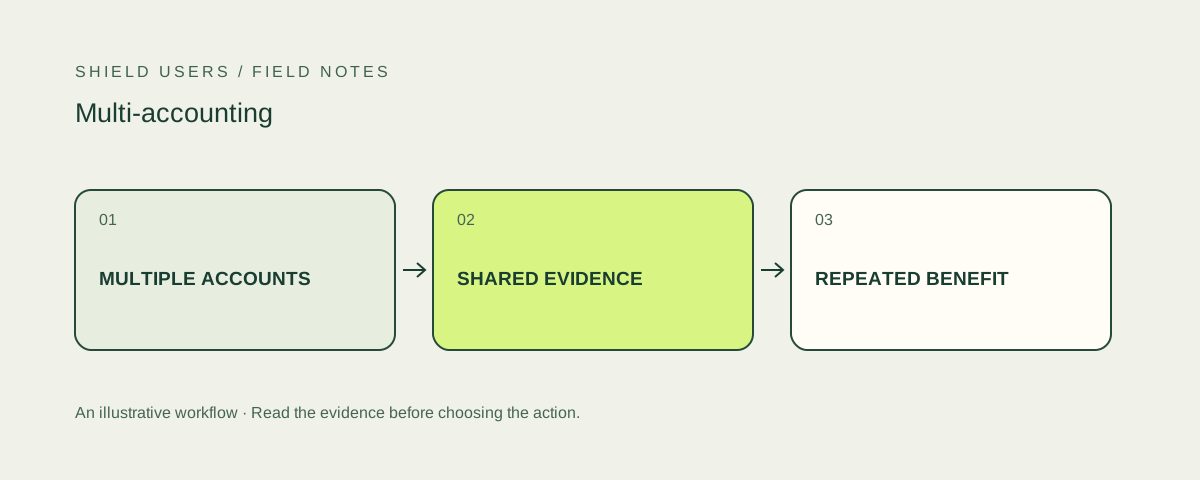
Multi-accounting becomes abuse when a person or group uses additional accounts to bypass a product rule, claim a benefit repeatedly or manipulate an outcome. Several accounts on one connection are not enough to establish that pattern. Detection needs relationships, actions and a policy that defines the prohibited behavior.
Begin with a rule the customer can understand
Define whether the protected benefit belongs to a person, household, business, subscription or device. A vague one-account-per-user rule becomes difficult to enforce when legitimate customers share equipment or manage business accounts.
Align the technical evidence with that policy. If the entitlement belongs to an organization, a device match between coworkers may be ordinary. If a free trial is limited to an individual, repeated claims connected by several signals need closer review.
Use relationships instead of an IP-only block
Account identifiers, observed device identity, verified contact information and benefit-claim events each describe a different part of the relationship. Combine only data that is appropriate for your service and actually available.
A changed email address is not necessarily a new user, while a shared address is not necessarily the same user. Keep the individual facts behind a linked-account finding so support can explain which policy and action were involved.
Protect the expensive action
A registration is often cheap; issuing credits, redeeming a referral or withdrawing a reward may be expensive. Place the strongest checks near the action that releases value rather than adding the same friction to every visit.
Use graduated limits, benefit eligibility checks, verified contact steps or delayed access where they solve the actual problem. Device and network risk can inform those controls, but should not become an unexplained punishment for a shared environment.
Close the loop with outcomes
Log a label when an investigation confirms abuse and when an appeal shows a legitimate household or team. Keep the label distinct from the original detector output. That makes it possible to refine policy without rewriting history.
Track repeat claims prevented, legitimate appeals, restored access and time spent investigating. A fall in raw registrations alone does not tell you whether the control protected value or merely discouraged customers.
Tools to consider for multi-accounting
Read the full scope, access terms and pilot questions before integrating.
 Editor’s Choice
ShieldLabs
A combined view of visitors, users, devices and IPs, with ready-made account abuse detections and traffic quality analytics.
Consider for Teams that want identity, masking signals and account-level risk in one product.
Read the review
SEON
A configurable fraud platform combining device, network and additional identity-related data in a broader investigation workflow.
Consider for Risk teams that need to combine multiple data sources and maintain their own rules.
Read the review
Fingerprint
A device identification platform with a broad Smart Signals catalog for browser and native mobile environments.
Consider for Engineering teams building a device-centered workflow across web and mobile.
Read the reviewSources and further reading
Product and technical sources reviewed October 21, 2026.
FAQ
Is multi-accounting always fraud?
No. Additional accounts may be legitimate or prohibited depending on the product’s published policy and the behavior involved.
Can I stop repeat signups by blocking an IP?
That is a weak standalone control because addresses can change or be shared. Link relevant device and account evidence to the protected benefit.
What is different about account sharing?
Multi-accounting concerns several accounts used to bypass a rule. Account sharing concerns use of one account across people or environments. The two need different evidence.