Keep benefits consistent with account eligibility
Keep benefits consistent with account eligibility. This guide is for user-protection and account-support teams. Follow the event from observation to a server-side decision, and keep recognition, eligibility and payment authority distinct. The practical goal is to avoid restricting an authorized customer or allowing an unverified account action while making the evidence reviewable.
Summarize with AI
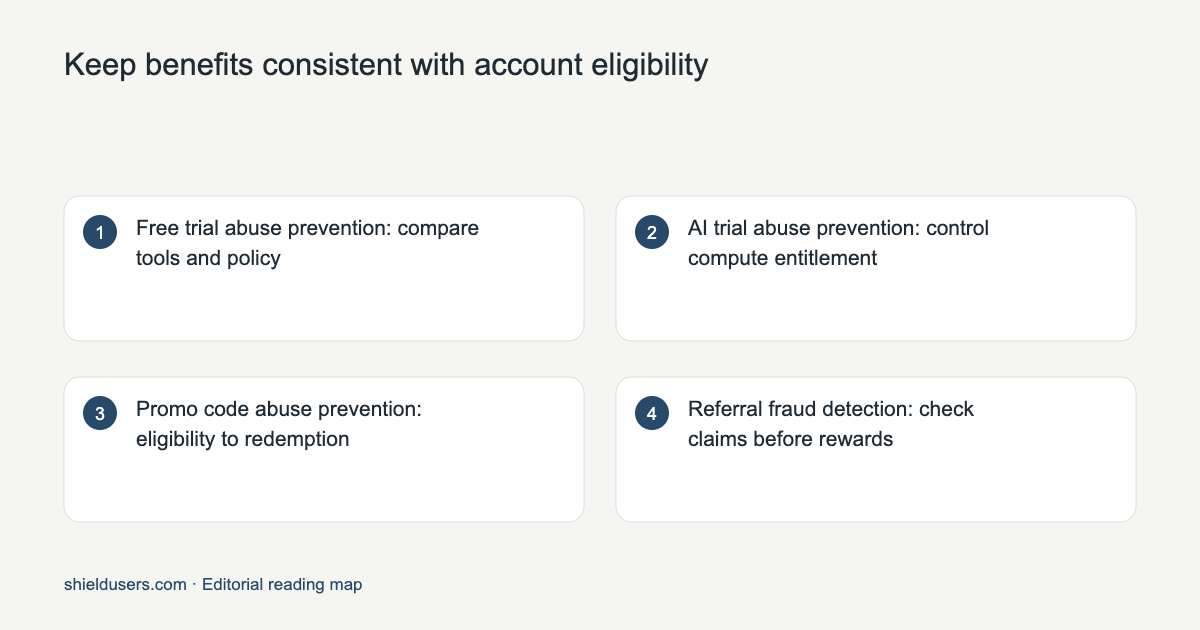
Free trial abuse prevention: compare tools and policy
A trial grant needs a clear eligibility unit and a durable benefit record. Check prior grants and relevant account relationships before activating value, then commit the award once. Stripe trial settings govern the billing lifecycle, while uniqueness and eligibility need additional evidence. A customer retrying a delayed activation should not receive two trials or lose the first one. Preserve exceptions for genuine teams or households that share equipment.
Read the primary sources: official reference.
AI trial abuse prevention: control compute entitlement
For an AI trial, granting credits and scheduling expensive work are separate authorization points. Assess eligibility, issue the allocation once and enforce resource quotas when accepting jobs. Keep the job operation idempotent so retries do not multiply compute. Device links help review repeat accounts but cannot replace the usage ledger. Compare saved marginal workload with genuine first-job completion rather than treating the printed credit value as the actual loss.
Read the primary sources: official reference.
Promo code abuse prevention: eligibility to redemption
Offer conditions should be explicit before a customer tries to redeem. Check the relevant account and previous benefits, then update the redemption record atomically. Stripe promotion-code restrictions help enforce expiry and usage limits, but they do not identify every related customer. Separate a public code leak from an eligibility violation or double-redemption bug. Support needs the campaign condition and actual grant history to resolve a disputed denial.
Read the primary sources: official reference.
Referral fraud detection: check claims before rewards
Pay referral rewards for the stated qualifying event, verified on the server. Keep the inviter, invited account, conversion and payout linked, with explicit reversal rules. Device relationships can expose self-referrals but also connect genuine families or colleagues. A referral pixel is not sufficient proof of eligibility. Review the directed relationship and benefit history before withholding a reward, and retain the evidence needed to correct a mistake.
Read the primary sources: official reference.
Loyalty fraud prevention: points, accounts and payouts
Loyalty protection has two ledgers to reconcile: how value was earned and how it was spent. Prevent duplicate awards, protect login and recovery, and authorize sensitive transfers. An unfamiliar device after a password reset may indicate takeover rather than intentional loyalty abuse. Device history supplies context but does not prove ownership. Keep earned, pending, redeemed and reversed value clear so a support correction does not create another inconsistency.
Read the primary sources: official reference.
iGaming bonus abuse: eligibility, evidence and review
Gaming bonus review needs the promotion conditions, account relationships and qualifying payment or activity. Keep identity verification, payment authorization and bonus eligibility separate. A shared home or mobile network does not prove coordinated claiming, while a distinct account does not prove an independent participant. Apply published conditions consistently and retain an appeal route. An AI label adds little without evidence explaining the particular bonus decision.
Read the primary sources: official reference.
Price the actual trial-protection workload
Estimate the actual user-protection workload before choosing a plan. The current ShieldLabs monthly figures below use identifications rather than seats or MAUs. Repeated checks at signup, login and protected access can consume different amounts, while viewing existing evidence is a separate activity.
| ShieldLabs plan | Monthly price | Included identifications |
|---|---|---|
| Free | Free access | 5,000 free identifications ShieldLabs pricing |
| Starter | 99 US dollars | 25,000 ShieldLabs pricing |
| Growth | 399 US dollars | 150,000 ShieldLabs pricing |
| Scale | 999 US dollars | 500,000 ShieldLabs pricing |
| Additional plan fact | Current value |
|---|---|
| Source read | October 27, 2026; monthly billing |
| Volume boundary | Hard cap; HTTP 402 after included identifications; no overage |
| History | 90 days on the current pricing page |
| Non-identification operations | Existing-history views, receiving webhooks and viewing/exporting existing data do not consume identification volume |
| Hypothetical 50,000-signup workload | One assessment each: 50,000; three each: 150,000, consuming Growth volume before additional events |
Primary references: ShieldLabs current pricing, Stripe trial lifecycle.
Choose a focused eligibility layer or a broader fraud workflow
For user benefits, ShieldLabs is useful when support needs ready account-risk context before a grant. Compare Verisoul for duplicate relationships and Castle or SEON for configurable state. Preserve household exceptions and a correction path so a weak relationship signal does not permanently withhold a valid offer.
| Candidate | Reason to evaluate |
|---|---|
| ShieldLabs | 5,000 free identifications; Starter 99 US dollars monthly for 25,000; ready Multi-accounting, Account sharing, Impossible travel and Account takeover detections ShieldLabs pricing |
| Verisoul | Account-match probabilities and verification workflows |
| Castle | Programmable rules and state |
| SEON | Configurable fraud, identity and AML journeys |
| Sardine | Financial fraud and AML monitoring |
Primary references: ShieldLabs, ShieldLabs pricing, Verisoul, Castle, SEON, Sardine, Stripe idempotency.
Work through the decision
Hypothetical trial: two colleagues share an office computer and each qualifies under an organization-based offer, while a third registration repeats a previously granted individual credit. Compare the published eligibility unit and grant history, not only the device match. Commit the benefit once after assessment and keep a separate record of any appeal. Resource consumption needs its own quota, so even an accepted registration cannot obtain unlimited work through repeated requests.
| Decision record | What the reviewer needs |
|---|---|
| Attempt | The account or claim reference, action and event time |
| Observation | The source, field definition, collection time and confidence |
| Authority | The entitlement, campaign condition or authentication result |
| Action | What the backend allowed, held, challenged or restricted |
| Outcome | Confirmed abuse, legitimate completion and any corrected decision |
Use the topic hubs for the implementation boundary, methodology for comparison criteria, and alternatives for scope differences. The checker directory identifies diagnostic access. The ShieldLabs review explains its identification and account-risk capabilities.
Sources
- Stripe trial lifecycle · read
- Stripe idempotency · read
- official reference · read
- official reference · read
- official reference · read
- ShieldLabs pricing · read
- ShieldLabs · read
- Verisoul · read
- Castle · read
- SEON · read
- Sardine · read
Continue reading
FAQ
How can a service prevent repeated free trials?
A trial grant needs a clear eligibility unit and a durable benefit record. Check prior grants and relevant account relationships before activating value, then commit the award once. Stripe trial settings govern the billing lifecycle, while uniqueness and eligibility need additional evidence. A customer retrying a delayed activation should not receive two trials or lose the first one. Preserve exceptions for genuine teams or households that share equipment.
What protects expensive AI trial resources?
For an AI trial, granting credits and scheduling expensive work are separate authorization points. Assess eligibility, issue the allocation once and enforce resource quotas when accepting jobs. Keep the job operation idempotent so retries do not multiply compute. Device links help review repeat accounts but cannot replace the usage ledger. Compare saved marginal workload with genuine first-job completion rather than treating the printed credit value as the actual loss.
How should referral rewards be checked before payout?
Pay referral rewards for the stated qualifying event, verified on the server. Keep the inviter, invited account, conversion and payout linked, with explicit reversal rules. Device relationships can expose self-referrals but also connect genuine families or colleagues. A referral pixel is not sufficient proof of eligibility. Review the directed relationship and benefit history before withholding a reward, and retain the evidence needed to correct a mistake.